How to become a therapist in the US depends on which of four licenses you pursue, and this page compares them side by side. Last updated: September 3, 2026. Every salary and job-growth figure below is dated to its Bureau of Labor Statistics release. Licensing figures (hours, exams) are set by each state and are flagged for verification with your own state board — this page does not give one national hours number, because there isn’t one.
On this page
- The short answer
- The four license paths, side by side
- What a therapist is, and how the titles differ
- How to become a therapist: the path, step by step
- How long it takes and what it costs
- Salary and job outlook
- Common questions from career-changers
- Sources
The short answer
“Therapist” is not one license. In the US it is an umbrella word for at least four different licensed professions, and which one you pursue decides your degree, your exam, your supervised hours, and your pay. The four are the licensed marriage and family therapist (LMFT), the licensed professional counselor or licensed mental health counselor (LPC / LMHC), the licensed clinical social worker (LCSW), and the licensed psychologist.
Three of the four require a master’s degree; the psychologist requires a doctorate. All four require post-degree supervised clinical hours (the count is set by your state, not by any national rule), a passing score on a national exam, and a license from your state board.
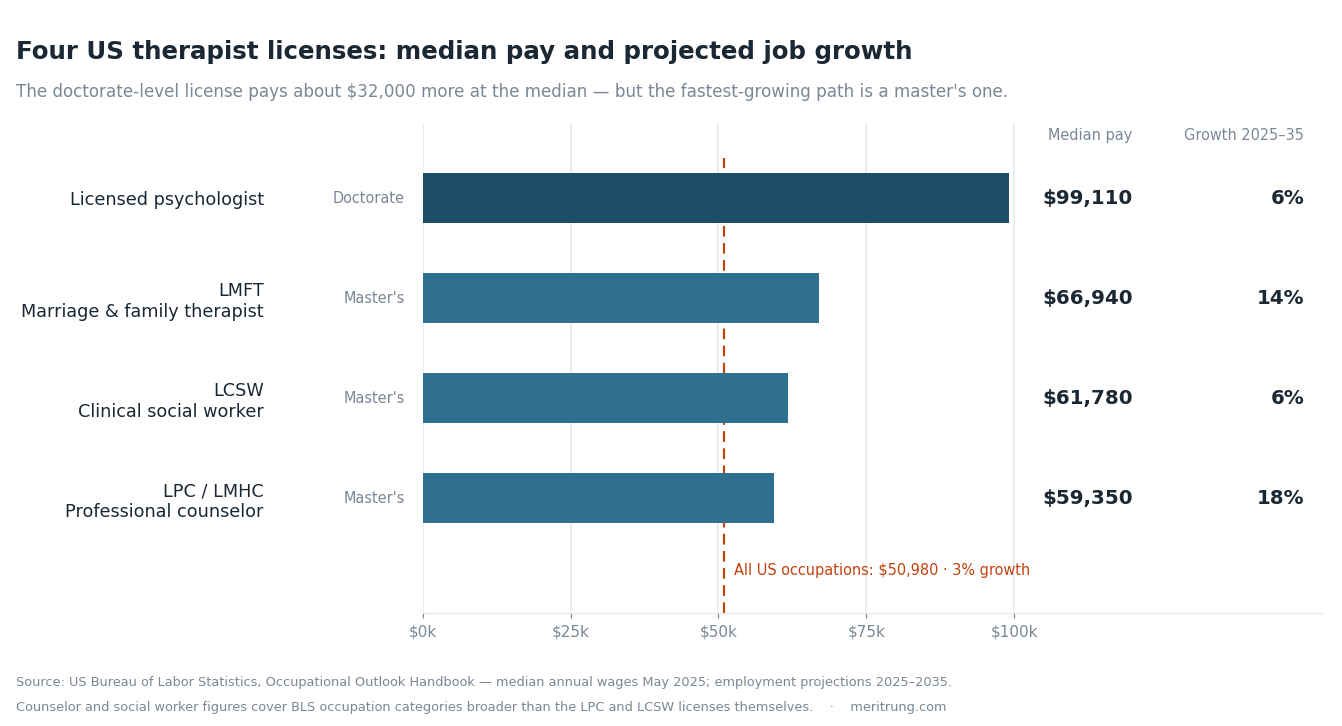
The median pay differs by profession. As of May 2025 (BLS Occupational Outlook Handbook, read at source on September 3, 2026): substance abuse, behavioral disorder, and mental health counselors earned a median of $59,350 a year; marriage and family therapists, $66,940; social workers, $61,780; and psychologists, $99,110. Job growth through 2035 runs from 6 percent (social workers and psychologists) to 18 percent (counselors) — all faster than the 3 percent BLS projects for all occupations combined.
If you take one thing from this page: pick your license family first, then find your own state’s rules, because a supervised-hours count or exam that is true in one state is often wrong in the next.
The four license paths, side by side
This is the comparison no single-role page holds, because a page about “how to become a social worker” has no reason to put the LCSW next to the psychologist. Each number below carries its source.
| License | Degree required | Licensing exam | Typical duties (BLS) | Median pay (BLS, May 2025) | Job growth (BLS, 2025–35) |
|---|---|---|---|---|---|
| LMFT — Marriage & Family Therapist | Master’s in marriage and family therapy or related field, from an accredited program (COAMFTE accredits MFT programs) | AMFTRB National MFT Exam (some states add a jurisprudence exam) | Diagnoses and treats disorders in the context of couples, families, and relationships | $66,940 (BLS, SOC 21-1013) | 14% (BLS) |
| LPC / LMHC — Professional / Mental Health Counselor (name varies by state) | Master’s in counseling or clinical mental health counseling (CACREP accredits counseling programs) | NCE or NCMHCE, both administered by NBCC | Diagnoses and treats mental, emotional, and behavioral disorders through counseling | $59,350 for the BLS category that covers these counselors (BLS, SOC 21-1018) | 18% (BLS) |
| LCSW — Licensed Clinical Social Worker | Master of Social Work (MSW) from a CSWE-accredited program | ASWB Clinical exam | Diagnoses and treats mental, behavioral, and emotional disorders; also case management and advocacy | $61,780 for social workers overall; $60,280 for mental health and substance abuse social workers (BLS, SOC 21-1020) | 6% for social workers overall; 10% for mental health and substance abuse social workers (BLS) |
| Licensed Psychologist | Doctorate — PhD or PsyD in psychology (APA accredits doctoral programs and internships) | EPPP, administered by ASPPB | Assessment and psychological testing, diagnosis, and psychotherapy; some states allow prescribing | $99,110 for psychologists overall; $100,580 for clinical and counseling psychologists (BLS, SOC 19-3030) | 6% overall; 12% for clinical and counseling psychologists (BLS) |
A word on the two that get confused. A psychologist holds a doctorate and is the only one of the four who routinely does psychological testing and assessment; the other three enter with a master’s. A psychiatrist is not on this list at all — that is a physician (MD or DO) who prescribes medication, a different training track entirely. The BLS reports psychologist pay separately and higher than the master’s-level licenses, which answers the common “which pays more” question: the doctorate-level role does. Read that gap with care — the BLS occupations compared here are not four equivalent licenses, and the counselor and social worker figures cover categories broader than the LPC and LCSW licenses themselves.
What a therapist is, and how the titles differ
All four professions above provide psychotherapy — talk therapy to diagnose and treat mental, emotional, and behavioral problems. The difference is the lens and the entry credential. The LMFT is trained to treat the individual inside a family system. The LPC/LMHC is trained in individual and group counseling. The LCSW comes through social work, which also carries case management and advocacy. The psychologist adds formal assessment and testing.
“Counselor” and “therapist” are used loosely and often interchangeably in job postings, which is why the BLS does not publish a single occupation called “therapist.” It publishes separate occupations, and the pay figures above come from those separate categories. When a salary page quotes one “therapist salary,” ask which BLS occupation it is drawn from.
How to become a therapist: the path, step by step
Step 1 — Earn a bachelor’s degree. For the three master’s-level licenses, the specific undergraduate major is usually not mandatory. The BLS notes that a master’s in social work does not require a bachelor’s in social work, and that MFT applicants may hold a bachelor’s in psychology or a related field. What matters is meeting the prerequisite coursework your graduate program lists. Psychology, social work, and social science are common majors, but they are not the only doors in.
Step 2 — Choose your license, then a licensure-track graduate program. This is where the four paths split. For LMFT, LPC/LMHC, or LCSW, you need the right master’s — and the accreditor matters, because many state boards require a degree from an accredited program: COAMFTE for MFT, CACREP for counseling, CSWE for social work. For psychologist, you need a doctorate (PhD or PsyD) from an APA-accredited program, which per the BLS typically includes an internship. Do not take one school’s advertised program length as the general timeline; the BLS describes doctoral study as an advanced degree with internship, and program lengths vary widely by institution.
Step 3 — Complete supervised clinical hours. After the degree, every path requires post-degree supervised clinical experience before licensure. The number of hours is set by your state and by your license type — there is no single national figure. The BLS states plainly that for psychologists “the required number of hours for internships varies by state,” and for clinical social workers that “the length of clinical training varies by state.” Anyone quoting one hours number as the national rule is quoting one state. Verify yours before you plan around it (Step 5).
Step 4 — Pass your licensing exam. Each path has its own national exam: the AMFTRB National MFT Exam for LMFTs; the NCE or NCMHCE (both from NBCC) for counselors; the ASWB clinical exam for LCSWs; and the EPPP (from ASPPB) for psychologists. Some states add a state-specific law-and-ethics or jurisprudence exam on top of the national one — the BLS notes some states require a jurisprudence exam for MFTs, for example.
Step 5 — Find your own state’s rules and apply to your board. This is the step that decides whether the previous four were planned correctly, and it is the one most guides skip. Licensing is set state by state: the required hours, the accepted exams, the accepted degree programs, and even the license name all change at the state line. LPC in one state is LMHC or LPCC in another.
The BLS points readers to state licensing boards through the CareerOneStop license finder (careeronestop.org licensed occupations tool), which lets you select your occupation and state and links you to your board directly. Reproduce the rule from your board’s own page — do not rely on a paraphrase, including this one, for the exact count.
How long it takes and what it costs
The honest answer is a range tied to license and state, not a fixed number. A master’s-level path (LMFT, LPC/LMHC, LCSW) runs roughly: about four years for the bachelor’s, then a master’s the BLS describes as generally two years (the MSW “generally take[s] 2 years to complete,” and some programs let BSW holders finish in under two), then post-degree supervised hours that the BLS says take from a year to several years depending on your state and whether you accrue them full or part time. The psychologist path is longer because it requires a doctorate plus internship and post-doctoral supervised experience.
On cost, this page does not publish a single tuition figure, because tuition is set per institution and there is no national number that would be true across programs. For a specific program’s published cost, the source that carries it is the institution itself or the federal IPEDS data; treat any school’s own timeline or price as institution-specific, not a general fact.
Salary and job outlook
All figures below are median annual wages from the BLS Occupational Outlook Handbook, May 2025 data, read at source on September 3, 2026. Growth figures are BLS projections for 2025 to 2035.
Marriage and family therapists: median $66,940; the lowest 10 percent earned less than $44,650 and the highest 10 percent more than $123,730; projected growth 14 percent.
Substance abuse, behavioral disorder, and mental health counselors (the category covering LPC/LMHC work): median $59,350; projected growth 18 percent.
Social workers overall: median $61,780; lowest 10 percent under $42,790, highest 10 percent over $100,090; projected growth 6 percent. Within that, mental health and substance abuse social workers had a median of $60,280 and 10 percent projected growth.
Psychologists overall: median $99,110; lowest 10 percent under $59,080, highest 10 percent over $163,380; projected growth 6 percent. Clinical and counseling psychologists specifically had a median of $100,580 and 12 percent projected growth.
For comparison, the BLS median for all workers was $50,980 in May 2025, and projected growth for all occupations is 3 percent from 2025 to 2035. All four therapy paths pay above that median and are projected to grow faster.
One correction worth flagging, since it circulates on competing pages: some guides state “19 percent projected growth through 2033.” No current BLS projection matches that pairing. The BLS figure for mental health counselors is 18 percent for 2025–35, and for MFTs it is 14 percent. Use the number your source can actually show you on a BLS page.
Common questions from career-changers
Can you become a therapist without a psychology degree? For the master’s-level licenses, often yes. The BLS states that a bachelor’s in almost any field can qualify you for an MSW program, and that MFT applicants may hold a bachelor’s in psychology “or a related field.” What you need is the prerequisite coursework the graduate program requires, not necessarily a psychology major.
Can you become a licensed therapist without any degree? No. All four licensed paths require a graduate degree — master’s or doctorate — per the BLS. Roles that do not require a degree, such as peer-support specialist or life coach, are real jobs, but they are not licensed therapist roles. What an unlicensed role may and may not do is set by state law, not by this page — your state board is the source that carries it. If a page implies otherwise, it is blurring “therapist” with an unlicensed role.
Are online or accelerated programs real? Distance and part-time programs exist for several of these degrees. The gate is accreditation and your state board’s acceptance: an online degree that is CACREP-, CSWE-, COAMFTE-, or APA-accredited (as your license requires) and accepted by your state board counts the same as an in-person one. Confirm both the accreditation and your board’s acceptance before enrolling — that is what determines whether the credit counts toward licensure.
Is it hard to become a therapist? The measurable parts are the ones above: multiple years of graduate school, thousands of supervised hours whose exact count your state sets, and a national exam. This page reports what the path requires, not whether it is right for you — that is a decision only you can make against those requirements.
Sources
Bureau of Labor Statistics, Occupational Outlook Handbook, all data May 2025, read at source on September 3, 2026:
Marriage and Family Therapists (SOC 21-1013) — median $66,940; 14% growth 2025–35; percentiles and licensing summary. https://www.bls.gov/ooh/community-and-social-service/marriage-and-family-therapists.htm
Substance Abuse, Behavioral Disorder, and Mental Health Counselors (SOC 21-1018) — median $59,350; 18% growth 2025–35. https://www.bls.gov/ooh/community-and-social-service/substance-abuse-behavioral-disorder-and-mental-health-counselors.htm
Social Workers (SOC 21-1020) — median $61,780; 6% growth overall, 10% for mental health and substance abuse social workers; clinical social worker licensing summary. https://www.bls.gov/ooh/community-and-social-service/social-workers.htm
Psychologists (SOC 19-3030) — median $99,110; $100,580 for clinical and counseling psychologists; 6% growth overall, 12% for clinical and counseling psychologists; doctoral and licensing requirements. https://www.bls.gov/ooh/life-physical-and-social-science/psychologists.htm
State licensing boards, via CareerOneStop’s licensed-occupations finder (the source the BLS itself directs readers to for state-by-state requirements). Use it to locate your own board and read the current rule for your license and state. https://www.careeronestop.org/Toolkit/Training/find-licenses.aspx
Exam and accreditation bodies named above are the authorities for their own requirements: NBCC (NCE, NCMHCE), ASWB (clinical social work exam), AMFTRB (National MFT Exam), and ASPPB (EPPP); COAMFTE, CACREP, CSWE, and APA for program accreditation. Confirm current exam and accreditation details on each body’s site, as they change over time.
A note on what this page does not claim: the supervised-hours counts are set by 50 different state boards and are not reproduced here as a single number, because a count that is correct in one state is usually wrong in another. Where you need the exact figure, the state board is the source that carries it — not this page, and not a competitor quoting one state as if it were national.
meritrung reports US career paths from published federal data and the licensing authority that sets each rule; this guide is one of them.
This is a career-information page, not medical, legal, or financial advice. Requirements and figures change; verify the current rule with your state board before making a decision.